


The Sunday Scan
Seven questions. Fifteen minutes. And the week they caught what I was explaining away.
This post was supposed to go out last Tuesday.
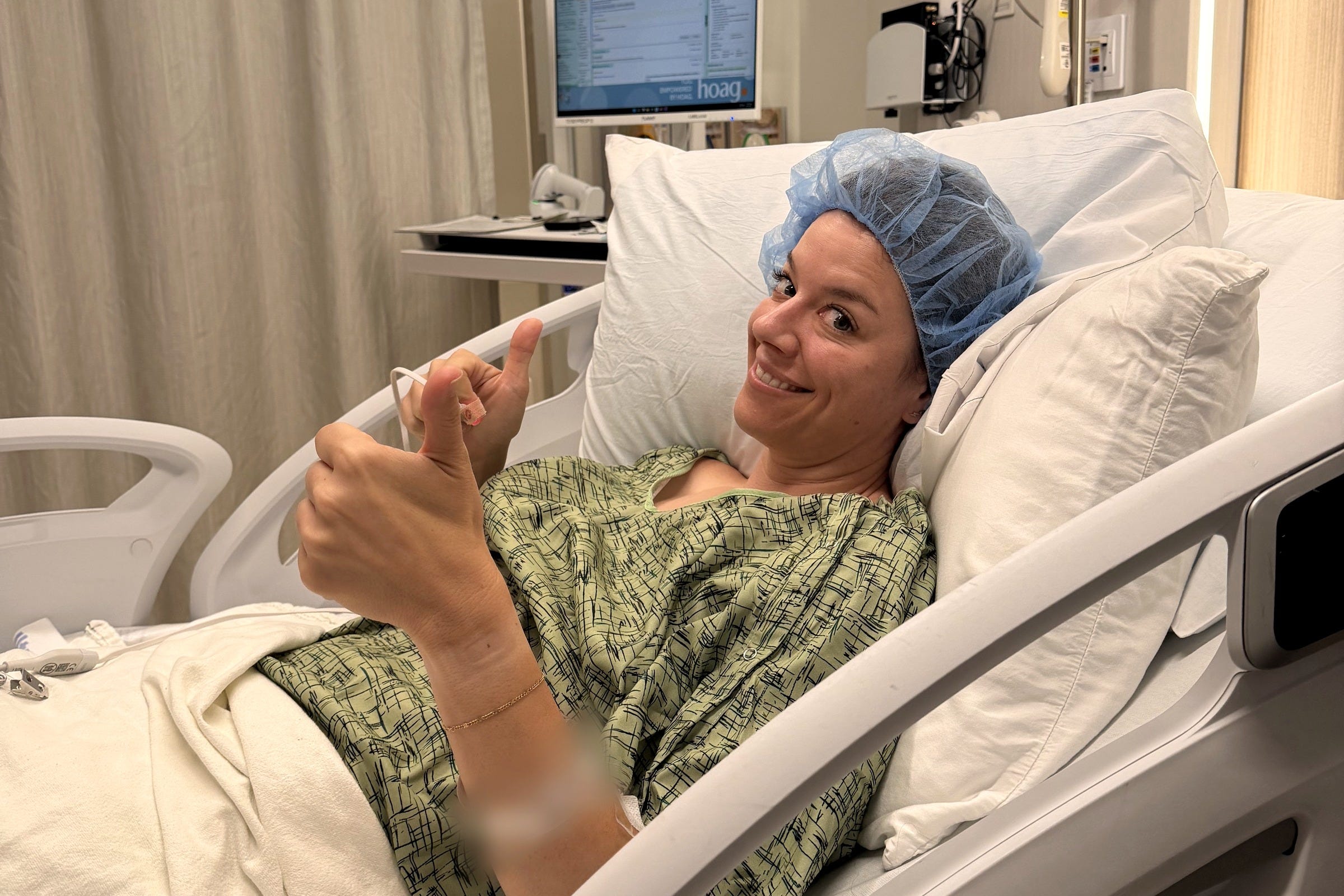
I was in the ER instead. Fun times.
The week before, I’d been in New York with my six-year-old: three trade shows, one weekend, and a kid who wanted to see everything.
Gelato on the 86th floor of the Empire State Building. A street pretzel at the LEGO store. An insanely good, extremely carnivore-heavy dinner at Vinyl Steakhouse.
Fat is the exact thing a gallbladder full of stones cannot deal with.*
*Less dramatic, more medically accurate: fatty meals are a classic gallbladder-problem trigger because eating tells the gallbladder to release bile, and stones can get in the way. Sexy, I know.
I knew that. I ate it anyway.
You know, vacation calories don’t count.
Except they did.
Your girl’s gallbladder started disliking life.
A LOT.
If you’ve never had a gallbladder attack, mine feels like a deep, gripping pain under my right ribs that wraps around into my back and up under my right shoulder blade.
It does not care what position I lie in.
Mine does not feel like indigestion.
Mine announces itself.
Aggressively.
This was not the first, third, or tenth time.
Probably the twentieth in ten years.
Yessss, I know.
I can hear you.
But every other time, if I stopped eating, hydrated, slept, and wore looser pants, I’d be fine in a day or two.
So when it started again, I did what had worked before.
And then I just kept moving.
Getting home from New York was its own event.
On Sunday, we spent three hours on the tarmac before they deboarded us and canceled the flight.
I left my laptop on the plane and didn’t realize for hours.
We finally landed Monday night, with my found laptop (PTL!), 25 hours after our original arrival time.
I would love to tell you I clocked any of this as a sign.
I did not.
I filed it under “travel can be hell” and kept going.
Tuesday, I sat down to get this post ready.
I worked down my own list, the one I’ll give you in a minute, and hit the body section.
I’ll say this with as much humility as I can manage:
If anyone I loved had handed me those answers, I would have driven them to a hospital myself.
Seeing it written down made it very hard to keep pretending.
By then, I was on day three of a raging gallbladder attack. Forty-eight hours without food because I knew anything I ate would make it worse.
Bloated.
In pain.
Exhausted.
And still moving, because apparently that is a personality trait I am working on.
I had already committed to picking up my daughter and her bestie from horse camp. When it came time for dinner, her mom took one look at me and said, “Go. I’ve got them.”
God bless Becca. The woman is a saint.
Then I called my parents to say I’d be at an ER near them in a few hours.
Oh joy.
The phone call every parent dreams of.
I drove the hour to Irvine instead of going somewhere in LA because I cannot overstate how much you want someone with you in an ER when you are not at your best. Especially when it is the same ER where Dave nearly died.
The ER findings…
Ultrasound: gallbladder full of stones.
Lovely.
Labs: within range.
Great.
Me: hadn’t eaten in days, bloated, achy as hell, and looking exactly as good as that sounds.
I want to be honest about this part because the true version is not flattering.
I did not listen to my body.
But that isn’t quite the whole truth either.
Because I heard my body.
Loud and clear.
I knew I was in pain.
I knew I hadn’t eaten.
I knew this attack was lasting longer than the others.
I knew I did not feel right.
What I did was explain every piece of it away.
The flight was a nightmare.
I was tired.
I’d eaten like a college frat boy in New York.
Gallbladder attacks had happened before. They always passed.
I’d deal with it tomorrow.
And tomorrow.
And tomorrow.
The paper didn’t catch what was wrong with me.
It caught what I was explaining away.
That is the whole argument for doing this on a Sunday, when nothing is wrong.
I wish this were a lesson I learned last Tuesday.
It is not.
I have a very long history of feeling something, explaining it away, and occasionally being surrounded by people who were doing the exact same thing.
I learned that at twenty years old, the stupid way.
I went to Maryland on a softball scholarship, but the spring before I left for college, I tore my ACL.
So I arrived injured, rehabbing and already feeling like a problem.
No one was thrilled about that.
Not me.
Not the coaching staff.
Not my teammates.
A week before school started, I met our strength coach for the first time. I introduced myself, and she looked at me, completely deadpan, and said:
“You know what I hate? New people, fat people, and hurt people.”
I said, “Great, I think I qualify for all three.”
She said, “Yep.”
She was not kidding.
And that was the field we played on. Being hurt was a liability and everybody knew it.
By the end of freshman year, my trainer had nicknamed me “caution tape.”
Fair, honestly.
I had managed to tear an ACL, then have a softball ricochet off a batting dummy and break my upper jaw in three places.
Promptly followed by a surgery and a medically required grill. Like the rapper kind, but less sexy and more “please do not chew anything enthusiastically.”
I shit you not.
And through all of it, I kept telling anyone who would listen that my right knee, the rebuilt ACL, hurt.
Like hell.
Constantly.
For over a year.
Nobody really bought it.
And honestly, I don’t entirely blame them. I was tired of me too.
Then sophomore year, during a conditioning session, I tore my other ACL.
I knew immediately.
If you’ve torn one, you know. The body has a very specific:
“OMFG, did that just happen?” reaction.
My trainer tested the knee I had just injured, then tested my already-rebuilt right knee for comparison.
The right knee was looser.
So she told me there was no way I had torn the left one.
Probably a sprain. Ice it. Go to class. Rest.
She was right that my right knee was looser.
She was wrong about why.
Turns out the screw from my first ACL reconstruction had been failing for at least 18 months.
By that spring, there was no ACL left in my right knee at all.
I had a hole in my femur the size of a quarter and a hole in my tibia the size of a dime.*
*This shitshow deserves an entire post. We will get there eventually.
They used my right knee as the control.
My right knee had a hole in it.
Actually, two holes.
And yes, I had torn the left ACL too, which was confirmed five days later. After I still couldn’t walk and finally got an MRI.
I had been telling the truth about both knees.
The facts were there.
But there was already a story about me:
I was always hurt. I complained a lot. My rebuilt knee was “fine.”
And once the story existed, everything got interpreted through it.
That was the first time I understood how easily a story can become more convincing than the information sitting right in front of you.
Including the stories we tell ourselves.
It kept happening in smaller ways.
My early twenties.
Acid reflux so bad it felt like I’d gargled Jäger for six hours and my enamel was begging for mercy.
The gastroenterologist handed me a Prilosec prescription and suggested I drink less coffee.
No follow-up questions.
I didn’t love that answer, so I started paying attention to what I was actually doing.
At the time, I was basically waterboarding myself with Diet Coke at breakfast, lunch, and dinner.
So I stopped drinking with meals.
My reflux disappeared.
That does not mean I discovered the universal cure for reflux.
It means nobody had asked me what I drank, and changing one variable changed something in me.
Useful information.
The early 2010s.
I was experiencing persistent joint pain and stiffness after all the knee surgeries.
Gluten was suddenly the conversation everywhere.
A friend had just been diagnosed with celiac, so I went and asked for the test.
Endoscopy.
Result: negative.
Fine.
I ran the experiment anyway and cut gluten for 30 days.
Thirty days became a year.
My pain went away entirely. My weight dropped. I felt like I was in a different body.
Again: not proof of a universal anything.
Just data about my own body that I would not have had if I hadn’t gotten curious.
Nobody taught me to think that way about my health.
Not high school health. Not the athletic nutrition department in 2006.
I had the symptoms, so I became the experiment.
January 2025
My partner Dave was diagnosed with stage four colon cancer, and I became his caretaker and advocate.
A job I didn’t know I was taking and turned out to be very good at.
They gave him six months.
He got fourteen.
And during those fourteen months, I learned more about paying attention than I ever wanted to know.
Dave was in and out of the hospital for everything from bowel obstructions to intestinal hernias to blood infections, and every time we walked into a new room, there were new doctors, new nurses, new specialists, new people looking at one piece of what was happening.
I was the constant.
I was the person in the room who knew the whole story.
What medications he was on.
What he had stopped taking.
What treatment he was getting.
What he was eating.
What he could tolerate.
What had happened during the last hospital stay.
What had changed since the last set of labs.
What was normal for him and what absolutely was not.
And I researched everything.
Colon cancer. Treatments. Side effects. Holistic options. Clinical trials. Labs. Markers. Therapies. Complications. You name it, I rabbitholed it.
Not because I had suddenly decided to become an oncologist on Google.
Because I needed to understand enough to ask smart questions.
I needed to know which numbers mattered.
What his baseline was.
What was moving.
What wasn’t.
What we wanted to see go up.
What we absolutely did not want to see go up.
What looked scary but was actually normal for him.
And what looked technically “within range” but was very much not normal for my person sitting in that hospital bed.
I learned that a single data point can tell you something.
But a pattern can tell you a hell of a lot more.
And when nobody in the room has the whole pattern, sometimes you have to be the person who brings it with you.
There's a much bigger post in that one. This is just the part that belongs here.
But by then, knowing someone’s baseline AND noticing when it moved, was no longer a wellness concept to me.
It was a survival skill.
Which brings me back to last Tuesday.
And to the thing I was doing when I finally clocked that I was in trouble.
I call it the Sunday Scan.
Fifteen minutes.
Once a week.
Written down.
I’ve been doing some version of it for years, and I’m bad at doing it on a schedule, which is exactly why I gave it a name and a day.
Seven questions.
You are not hunting for something wrong.
Please do not turn this into a weekly game of What Disease Does Alex Think I Have Now?
That is a different and much worse activity that will not help you sleep or feel better.
The point is not to diagnose yourself.
The point is to know your own baseline well enough to notice when it moves.
What changed, and did it stay changed?
That’s it.
Because memory is weird.
Especially when you’re busy.
Especially when you feel like the ringleader of a shit circus and everybody needs something from you.
Especially when something has been off for so long that it starts feeling normal.
Most weeks, the answer will be nothing.
Nothing is a real answer.
In fact, that is part of the point.
When you have enough weeks of “this is basically normal,” a change has something to be compared to.
You are not grading your life.
You are paying attention to it.
Here’s the basics of The Sunday Scan
My fun.
Did I have any actual enjoyment this week? What made it good? What is one thing I can put on the calendar for the week ahead?
Not “I should plan something.”
An actual thing on an actual day.
If you do not schedule your fun, it does not happen.
Life just keeps on life-ing.
My people.
Did connection feel like too much, too little, or about right? Who filled me up? Who drained me? Who did I mean to reach out to?
My space.
Where did I spend most of my time this week? Is any part of that space affecting my mood, energy, or focus more than I’ve admitted?
My mind.
Did I feel wired, flat, steady, scattered, or stretched thin? Did I get any time that was actually mine?
My soul.
Faith, quiet, nature, intuition, prayer, meaning, or whatever language fits.
What helped me feel connected?
What did I need but not make room for?
My rhythm.
Sleep, energy, appetite, hydration, movement, cycle if relevant, and the overall pace of the week.
What pattern changed?
My body.
Work from head to toe so you do not skip anything.
What feels different from a month ago?
What changed and stayed changed?
What have I been explaining away?
And then the only part that makes any of it worth doing:
One thing.
Book the appointment.
Put the ninety minutes on the calendar with your name on it.
Send the text.
Make the call.
Not:
I should be better about that.
A thing. With a verb.
And when it needs one, a date and a time.
Because the things you only think about are the easiest things to explain away.
Writing them down makes the pattern harder to dodge.
What changed?
What did you do about it?
What are you doing next?
And yes, there is actual research underneath the boring part of this.
Progress monitoring tends to work better when we physically record what we’re tracking, and self-monitoring gets stronger when it is paired with an actual plan for what to do next.*
*Harkin et al. found that monitoring progress improved goal attainment, particularly when progress was physically recorded. Michie et al. found self-monitoring to be one of the more useful behavior-change techniques, especially when paired with action planning.
I mention that because apparently “Alex said so” has yet to clear peer review.
Rude.
But also because this is not a vague claim that journaling fixes everything.
It doesn’t.
This is much simpler than that.
You are creating a record of your own normal.
Then you are giving yourself a chance to act when normal changes.
Because you will not solve “one thing” on Thursday afternoon with three things already on fire.
You’ll notice it.
Think, “I should deal with that.”
And then not.
I have done this hundreds of times.
I’m an expert. lol.
The Sunday Scan PDF is free for subscribers. Subscribe and it lands in your inbox.
The Sunday version takes fifteen minutes.
The Tuesday version, in my case, took a hospital stay.
Okay, so that is the half you do when nothing is wrong.
There is a second half.
That is what you do once you are actually in the room.
I have a very fresh story about that because I spent last Tuesday night getting mildly difficult with an ER doctor and turned out to be right for completely the wrong reason.
That one is later this week.
In the meantime:
Fifteen minutes.
Sunday.
Pick one thing.
What have you been explaining away?
Reply and tell me.
I read all of them.
xo,
Alex
Love this!!! Thank you for this!!
Just downloaded! Thanks friend!
Now go and heal!
Sending love